Oct 29, 2026Company News
PTFE Fuel Line Guide: AN Sizes, E85, Braid and Kits
PTFE fuel line for E85 and pump fuel: how AN4 to AN12 map to hose ID, when nylon braid beats stainless, and what a resale kit needs.
Why the E85 car always ends up in the PTFE conversation


A shop takes in a car running E85. The owner complains about a fuel smell in the cabin and a line that went soft after two seasons. Nine times out of ten the hose on the car is a rubber braided line that was fine on pump 93 and is not fine now. That is the moment someone asks for a PTFE fuel line.
What follows is what we tell those shops, and what we tell the distributors who stock for them: sizes, braid choice, the fitting mistake behind most comebacks, and how to build a range that sells without parking cash in the wong SKUs.
E85 is not one fuel
People talk about E85 as if the ethanol contet s fixed at 85 percent. It is not. ASTM D5798 allows summer E85 anywhere from 51 to 83 percent ethanol depending on the market, and winter blends sit at the low end so the engine starts. A hose that survives one tank in July may see a very different mix in January.
Ethanol also carries water and oxygen with it. Rubber compounds absorb some of that, swell, soften, and start weeping through the wall. You smell it before you see it. On a daily driven car the smell is the early warning and the softened wall is the failure.
What changes when the tube is PTFE
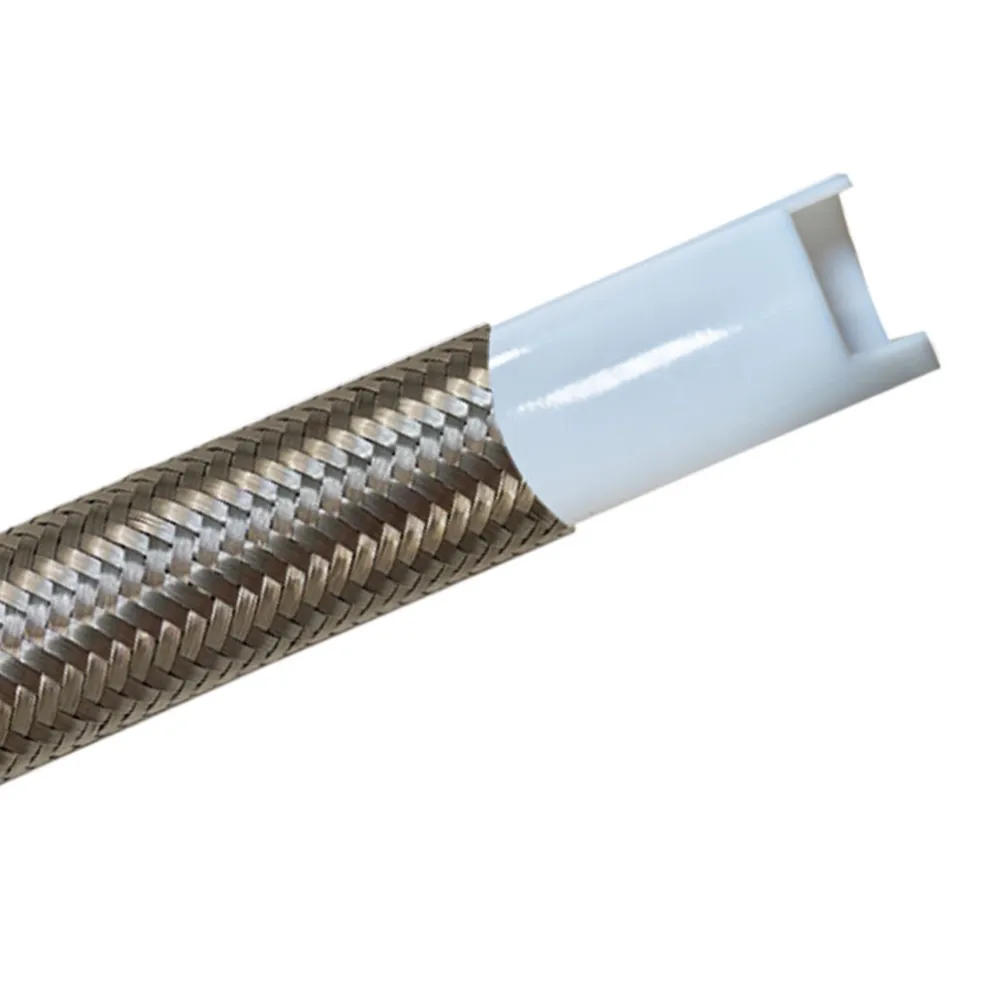
Teflon fuel hose is the same product under the name most buyers type into a search box. Teflon is a brand of PTFE, and the word now means the material to anyone who is not a polymer chemist, so a listing that says Teflon braided fuel line is worth reading closely: confirm the tube is PTFE and not a rubber liner with a slick coating.
PTFE is inert to ethanol, methanol, petrol, diesel and the additives in them. It does not swell and it does not plasticise. Permeation through the wall is close enough to zero that the fuel smell complaint usually goes away once the line is replaced.
The temperature window is wide, minus 55 to plus 210 °C on our SAE 100R14 hose, so heat soak near the rail and the tank stops being the limiting factor it is with rubber. The bore is slick, which matters less for flow than people assume and more for flushing the line clean.
The trade is mechanical. PTFE is stiff, it creeps under sustained clamp load, and every joint needs support. That last point is where most of the reported problems start.
Reading AN sizes without guessing
The dash number is the hose ID in sixteenths of an inch. It is not the outside diameter and it is not the thread size, which is where the confusion begins.
-4 is 1/4 in inside diameter with a 7/16-20 thread. -6 is 3/8 in with 9/16-18. -8 is 1/2 in with 3/4-16. -10 is 5/8 in with 7/8-14. -12 is 3/4 in with 1-1/16-12.

Listing titles write the same hose three ways: AN6 PTFE hose, -6 PTFE hose and 6AN all mean 3/8 in ID. AN8 is 1/2 in and AN4 is 1/4 in. When a number looks like a thread size, it usually is one, so check whether the seller quotes hose ID or fitting thread before you compare prices across suppliers.
On a modified car, -6 does most of the work. It flows enough for a mild turbo or a V8 swap, and it is the size customers ask for by name. -8 turns up on high horsepower builds and on feed lines from a surge tank. -4 is brake and clutch territory, which is reason enough to keep a roll. -10 and -12 are usually transfer lines rather than a fuel rail.
Do not size from a horsepower rule of thumb. Ask for the flow curve at your working pressure and check the pressure drop over the actual run. A -6 line over four metres at five bar loses very little; the same line at eight metres with six 90 degree ends loses enough to sag rail pressure on the top end. Measure pressure at the rail, not at the pump.
Nylon braid or stainless braid
The braid is not decoration. On a stainless steel braided PTFE hose the 304 wire carries the pressure and shields the tube from abrasion. On the black nylon version the braid does the same job at a lower pressure rating and lower weight.
The difference a shop feels is handling. Stainless braid is abrasive. It saws through nearby wiring and paint, it cuts fingers, and it needs a grommet every time it passes through a panel. Nylon braid bends tighter, feels like a hose instead of a spring, and is what most street builds end up with once the owner has seen both.
Stainless still wins near the exhaust and the turbo, where radiant heat will cook a nylon braid, and anywhere the line faces road debris. The common pattern is stainless in the engine bay and nylon from the firewall back.
Smooth bore or convoluted
Smooth bore gives the highest flow for a given ID and cleans out easily. Its weakness is bend radius. Force a smooth bore PTFE line into a tight 90 and the tube kinks internally, flow drops, and re-clocking the fitting will not fix it.
Convoluted tube, sometimes sold as corrugated PTFE, bends far tighter and resists kinking. It costs some flow and it is harder to clean. On a chassis that has to route around a cage or a fuel cell, convoluted saves hours. On a straight run down the tunnel, smooth bore is the better buy.
The fitting is where most installs fail
A PTFE line does not take the same hose end as a rubber braided line. Rubber AN ends grip the elastomer with a barb and a socket. That end on PTFE has nothing to bite, so the tube creeps out of the socket under pressure.
PTFE ends use a separate olive or ferrule that compresses the tube against a machined nipple. Fit the wrong end, or reuse an olive, and the joint weeps or lets go. This one mistake accounts for most of the “your hose failed” messages we get from shops that previously bought rubber line.
Cutting matters as much. Tape the braid, cut with a fine tooth blade or a chop saw with a fresh disc, and deburr the tube so the olive seats square. A cut at an angle leaks no matter how tight the nut is.

Static, the spec that gets skipped
Fuel moving through a non-conductive tube builds static. On a car with a fuel cell, a long run and no metal path to ground, that charge has nowhere to go. Conductive PTFE, made by loading the compound with carbon, carries it to the fittings and from there to the chassis.
If the build runs E85 into a plastic cell, ask for the conductive liner and bond the line to the frame. It is a cheap option at ordering time and an annoying retrofit later.
What a resale kit needs
A PTFE fuel line kit sells because the buyer does not want to hunt for fittings. The kits that move are the boring ones: a fixed length of hose, the right count of straight and 90 degree swivel ends, and a bag of clamps. Buyers who want to mix angles buy loose parts, not a kit.
-6 and -8 carry the kit range, in 10 ft and 20 ft. Black nylon braid outsells stainless in street retail by a wide margin. Put a short instruction sheet in the box with the cut and assembly steps, because a returned kit is usually an assembly question rather than a defect.
Swivel ends matter more than they look. A fixed end forces the hose to twist as the nut seats, and a twisted PTFE line tries to uncoil under the car. A swivel lets the nut turn without loading the tube.
PTFE hose fittings are the other half of the range and the part that eats margin when it is wrong. A swivel fitting kit with straight, 45 and 90 degree ends covers most builds; a shop that stocks only straight ends sends the customer to a competitor for the rest of the order.
PTFE fuel line kits — ready to order
We ship the kit range as four ready-to-order SKUs — AN6 10 ft kit, AN6 20 ft kit, AN8 10 ft kit and AN8 20 ft kit. Each is a black nylon braided PTFE line with four swivel ends, ready to cut and clock on the bench. Stainless braid, custom angle mixes and your label are available on the same MOQ.
Building the stock range as a distributor
Inventory cost sits in the slow sizes. A range covering -4, -6, -8 and -12 in two braids and four lengths will sit on the shelf for a year. Narrow it. -6 carries roughly half the volume, -8 takes most of the rest, -4 is a brake and clutch line, and -10 or -12 is a special order.
For a shop that builds its own assemblies, bulk coil plus a crimper beats a wall of pre-made lengths. For a reseller shipping to end users, the kit is the better unit, because the box is what the buyer photographs.
Keep one stainless braided SKU per popular size for the heat-adjacent jobs even if it turns slowly. That is the SKU that saves a shop in the middle of a build, and it is what makes them call back.
What to send for a quote
Six things decide price and lead time: dash size, braid material, length per piece, fitting type and angle (JIC, BSP, NPT or metric), whether the line needs a conductive liner, and the packaging. Send a drawing when the assembly is not standard.
We make the stainless steel braided PTFE hose from 3/16 in to 1-1/4 in (DN 5 to DN 32), smooth bore or convoluted, with a 304 braid, rated minus 55 to plus 210 °C and 600 to 1,500 psi by size. Nylon braid, cut lengths, crimped assemblies with your label, MOQ from 10 pieces.
Sizes, braid options and the assembly service are on the stainless steel braided PTFE hose page, and the full data table goes out with every quote. For the hot side of the same build we also supply silicone duct hose, and the hydraulic hose range covers the steering and lift side of a distributor catalogue.
Questions we get from shops and distributors
Will a PTFE line fix a fuel smell in the cabin?
If the smell comes from permeation through a rubber line, yes. If it comes from an injector seal or a rusty tank, no, and the new line will not change it.
How long does it last?
Five to ten years in normal use. Heat, vibration and a badly seated fitting shorten that far more than the fuel does.
Can I use my existing rubber hose ends?
No. PTFE needs its own olive or ferrule and a matching nipple. Reusing a rubber end is the most common cause of a joint that weeps.
Do you supply bulk coil or only assemblies?
Both. Bulk coil in the size you need, or crimped assemblies to length with your label.
Can you print our brand on the hose?
Yes, on the braid or on a sleeve, with the pressure rating and your part number. A minimum order applies.
Is it E85 compatible?
The tube is. Check the fittings and the seals in the rest of the system, because once the line is PTFE the hose is rarely the weakest part.
If you are pricing a range rather than a single line, send the size list and we will come back with a per-metre price, a lead time and the minimums for a private label run.