Oct 27, 2026Company News
TPU aeration tube for wastewater treatment: sizing and air flow
A TPU aeration tube puts fine bubbles along the floor of a treatment tank. How to size the run, read SOTE at your water depth, and pick TPU over EPDM.

What an aeration tube does in a tank
An aeration tube lies on the floor of an aeration basin and releases air along its whole length. The wall is a TPU membrane pierced with slit pores. Air pressure opens the pores. When the blower stops, the membrane closes and keeps mixed liquor out of the air line.
That last part matters more than the bubble count. A drilled pipe passes debris and sludge back into the header the first time the blower trips, and then you are cleaning a header instead of replacing a membrane.
Fine bubble and coarse bubble: where the power bill goes
Diffused aeration is usually the largest single load in a secondary treatment plant. The US EPA fine pore aeration design manual puts artion at 50 to 75 percent of total plant energy, and that range has not moved much in twenty years.
Bubble size decides how much of that air you actually use. Fine bubble membranes produce bubbles of roughly 1 to 3 mm. Coarse bubble diffusers make 6 to 50 mm bubbles from larger orifices. A 10 mm bubble carries about a tenth of the surface area to volume ratio of a 1 mm bubble, and it rises around three times faster, so contact time drops as well.
In numbers, a fine bubble tube gives about 4 to 6 percent oxygen transfer per metre of submergence. Coarse bubble gives 1.5 to 2 percent. At 5 m of water that puts fine bubble around 20 to 30 percent SOTE and coarse bubble around 8 to 12 percent.
Be careful with published SOTE figures. A number quoted without a depth is not comparable to another number quoted without a depth. Ask what depth, what airflow per diffuser and whether alpha was applied.
Tube or disc: the layout picks for you
Disc diffusers pack more transfer area into a square basin. Tube diffusers run in rows along a lane and are far easier to retrofit into long rectangular tanks, oxidation ditches and converted channels, because you can lay them on the existing pipework without rebuilding the floor grid.
A rough split that holds in practice: basins wider than about 6 m get discs, narrow lanes and retrofits get tubes. If your basin is 4 m wide and 30 m long, tubes. If it is 8 by 8, discs usually win on cost per unit of transfer area.
TPU against EPDM and silicone
EPDM is the default membrane in municipal plants because it is cheap and predictable. Silicone takes higher air temperatures. TPU sits between them on price and beats both on wall strength. A TPU membrane can be made at roughly a quarter of the wall thickness of a rubber one, which lowers headloss and blower energy for the same air flow.
TPU also resists oil and grease better, which matters in industrial effluent and in plants that receive restaurant or workshop discharge. The trade-off is stiffness. TPU needs a proper support and clamp, and cheap TPU with a high plasticiser load hardens in service. Ask for the plasticiser content and the flow curve, not just the material name on the quote.
How much air per metre
A 65 mm tube diffuser typically runs at 4 to 8 m³/h per metre of length, with 6 m³/h a common design point. Push past the top of that range and the bubbles merge, transfer efficiency falls and the slits wear faster. Drop below it and the membrane does not open evenly, so you get a few working patches and long dead sections.
Use the manufacturer flow curve rather than a rule of thumb, and keep at least 1 m of water above the tube so the plume has room to form.
Depth decides more than the diffuser does
Transfer efficiency climbs with submergence because each bubble has longer to dissolve. A tube at 6 m achieves roughly 50 percent more SOTE than the same tube at 4 m. This is why two quotes for the same tank can differ by a factor of two on blower size and both look reasonable on paper.
When you compare offers, ask each supplier for SOTE at your actual water depth with alpha and fouling applied. Alpha in municipal mixed liquor runs about 0.4 to 0.6 for fine bubble. Fouling takes another 0.7 to 0.9 off as the membrane ages and collects biofilm. A quote built on clean water numbers undersizes the blower, and the plant then runs short of dissolved oxygen on the morning peak.
What kills a membrane early
Running the blower against a closed header valve, or with the tube lifted out of the water, overheats the membrane. TPU tolerates a short dry run better than rubber, not an indefinite one.
On/off blower control flexes the slits thousands of times a day. The membrane survives it, but the slit edges fatigue and start passing larger bubbles. A VFD with dissolved oxygen control removes most of that cycling and usually cuts blower energy by 20 to 40 percent at the same time.
Oil, grease and iron scale block the pores from the water side. Cleaning restores part of the loss, never all of it. If the effluent carries heavy oil, plan the cleaning schedule before you buy, not after the first summer.
Ponds and aquaculture duty
Fish ponds and shrimp farms run the same tube at 1 to 2 m depth on intermittent blowers. The job there is holding dissolved oxygen through the night, when photosynthesis stops and oxygen demand from the pond bottom keeps going. Size for the night-time demand rather than the daytime average, and keep a spare blower. A pond that loses aeration at 3 a.m. loses the stock, not just the yield.
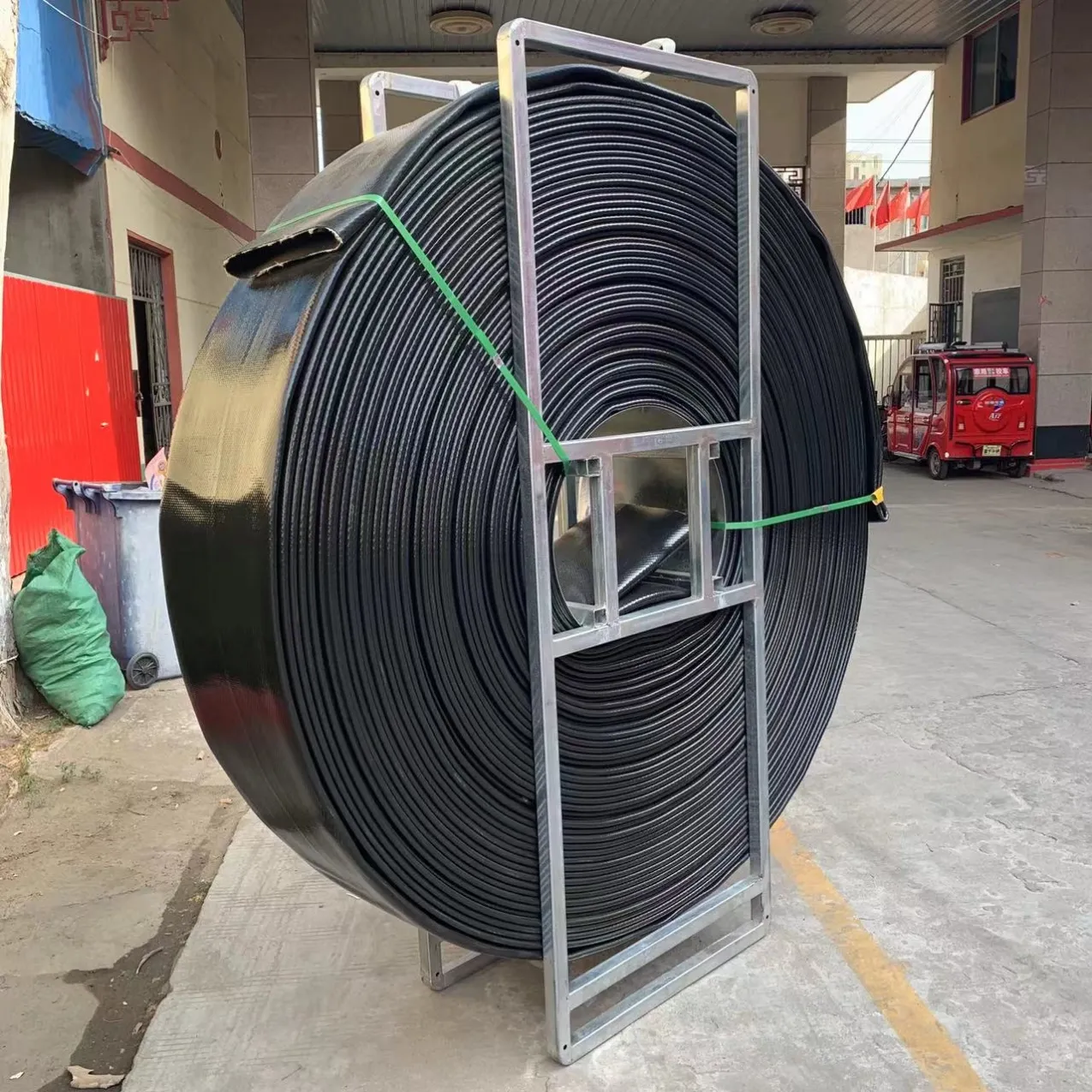
Most farms also move water for filling and draining. That side of the job usually runs on a layflat line, which is a different product from the diffuser: our TPU layflat hose covers it.
What to send us for a quote
Five numbers decide the layout: tank length and width, water depth above the tube, blower flow in m³/h at working pressure, target dissolved oxygen, and the spacing you want between runs. With those we can propose a tube length, a layout and a membrane grade. Without them any quote is a guess, and a guess on a 500 m order is expensive.
We supply the TPU aeration tube in white-blue and white-red, cut to length for the tank, with custom colours on request. MOQ is 500 m and the membrane carries REACH and ROHS documentation.
Questions buyers ask
How long does a TPU membrane last?
Five years is a fair planning figure, and plants that clean on schedule and run VFD blowers get longer. Water chemistry and blower control move the number more than the material does.
Can I replace only the membrane?
On a supported tube diffuser with a reusable carrier, yes. On a soft tube the whole length is replaced, which is also why the installed cost per metre is lower.
Will it run on my existing blower?
Check the pressure at the header, not the blower nameplate. A longer run or a fouled membrane raises back pressure, and a blower already at the top of its curve has nothing left.
Do you cut to length and print our label?
Yes. Length, colour, label and packing are made to order. Send the tank drawing and we will confirm the cut list before production.